


The morning air is crisp, you finally wake up with a clear head, you make yourself a fresh cup of coffee, and you settle down to write, buzzing with inspiration.
“Today is the day.” You can feel it in the air. You can feel yourself manifesting it.
You start strumming your guitar, with a fresh blank page open and pen in one hand. And then, nothing comes. The coffee gets cold. Disappointment settles in, and it’s frustrating because you’re subconsciously aiming it at yourself.
I’m sure we’ve all been there. And I want to talk about it because I think we treat being stuck like a personal deficiency when it’s actually one of the most universal experiences in any creative life.
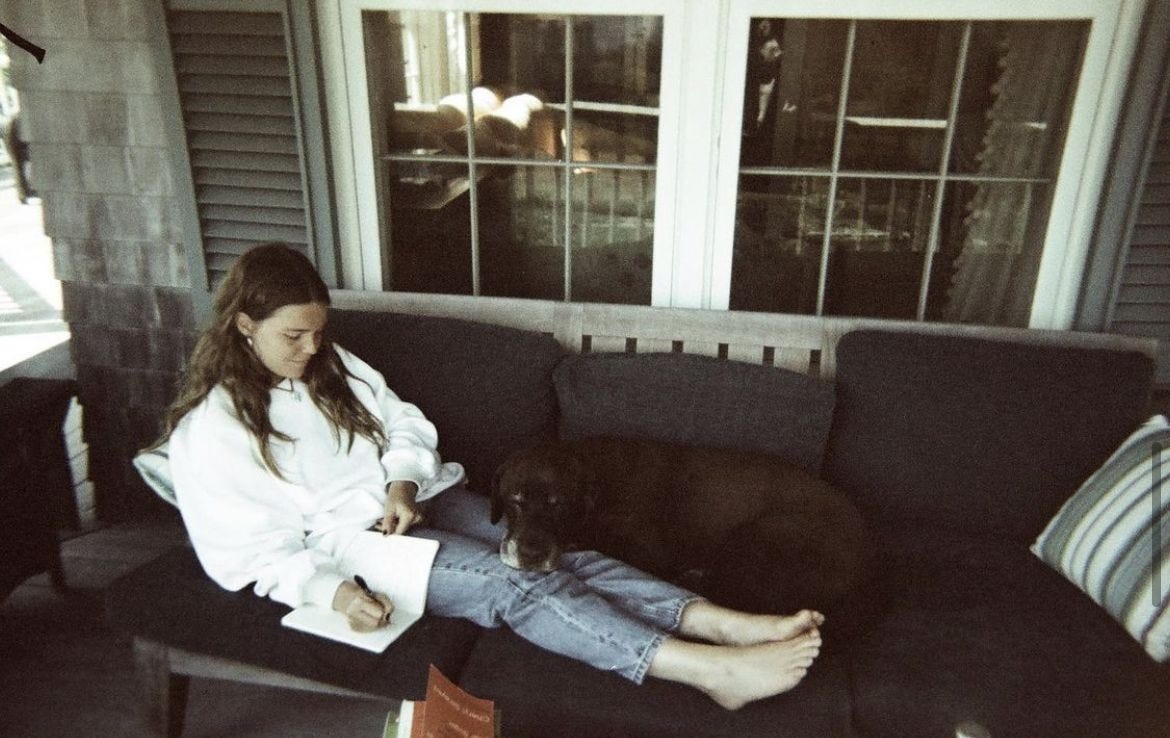
Maggie Rogers just did a conversation at NYU for the 10th anniversary of her viral moment with Pharrell, and there were some gems worth sharing. She talked about how “Alaska”, the song that changed everything for her, was technically written in 10 minutes, three days before she had to present it in class. But really, it took two years of not making any music at all to get there.
She put it simply: the record-making process is just measured as the number of days you were in the studio, and nobody counts all the living that happened before that.
That reframing matters because when you’re in the middle of what feels like a creative block, it can feel permanent and mess up your confidence. The way we measure creativity (in output, in posts, in streams, in how many songs you finished this month) makes the silence feel like inactivity when, sometimes, ideas are actually brewing behind the scenes.
Here are five reminders I want to share when you’re feeling stuck writing.
1. It’s Easier to Destroy Than to Create
It’s so easy to give up on an idea, scrap a draft, or convince yourself the idea wasn’t good enough. Destruction takes seconds. Creating something from nothing takes so much more.
The act of creating something that didn’t exist five minutes ago is one of the hardest things a person can do. And when you tell yourself that you’re blocked, you’re carrying the full weight of that difficulty without the relief of the output.
It is far harder and more painful to be a blocked artist than it is to do the work. The resistance, the avoidance, the guilt spiral of not creating. All of that takes more energy than actually sitting down and making something imperfect. Something as simple as writing one word down.
If you’re stuck right now, you’re already doing the hard part. But now you have to let go of perfection, or the expectation that anything you write down has to be brilliant. The physicality of writing is sometimes the only thing needed to access your flow state. You need to start before you can catch momentum. And regardless of whether you like the lyrics or not, the act of writing will feel lighter than carrying the burden of feeling blocked and trying to figure out why.
2. Creation Is Not Linear
Maggie Rogers talked about how she takes breaks every five or six years. Not because she runs out of ideas, but because what it means for her to be an artist keeps changing as what it means to be a human keeps changing.
She called it “renewing her artistic vows.”
In a world where hustle is rewarded, chasing virality has somehow translated into “doing the work.” But what good is it for your artistry if you’re just going through the motions on autopilot? Are you even being intentional with your output? Are you still being authentic?
During her last break, she went to grad school. She learned to surf. She got into Japanese films on Criterion. She went to Antarctica. And then she came back and made her album, Don’t Forget Me in five days, in track list order, recording two songs a day.
The living was a necessary part of the writing until she could hit record.
When asked if she was currently in a resting time or a making time, she said:
“Resting time IS making time.”
I know this is a statement many of us feel guilty for even admitting. I feel ashamed sometimes when I'm not "making" or "doing", and just want to spend the day walking around like an open book, my antennas out to gather inspiration, because it doesn't look busy or productive. Which, I realize, is silly, because I'm spending energy worrying about how I look when creation has never been linear.
If you’re struggling right now, that struggle is information. It means something is shifting, or maybe you need to live more, or maybe you need to slow down. Maybe you need to experience new things or feel the world around you. Your identity as an artist is evolving past the version of yourself that made the last thing. The fact that you can feel the friction means you’re already moving toward something new.
3. It’s Never Too Late
This one is simple, and I think we all need to hear it more often than we do.
There is no expiration date on your creativity. There is no age cutoff for making your best work. There is no timeline you were supposed to follow that you’ve fallen behind on.
Maggie Rogers killed her own radio campaign for “Alaska” because the song was getting bigger than she was ready for. She put a kibosh on “Alaska” becoming a pop radio hit, which sounds absurd for an up-and-coming artist. But every artist has different goals, and her goal was to have a sustainable career and become an album artist. She said if just one song became bigger than her, and took her to levels she wasn’t fully capable of yet, she would never get the chance to think in long form again. She chose slow growth over fast attention. She toured the world for a year and a half on five songs.
That’s a person who understood that her timeline was her own and was self-aware enough to understand her capabilities and limits.
Of course, it’s not easy to slow down when the rest of the world seems to want you to move forward with them. You lose out on opportunities you might never have again. But you are allowed to move at whatever pace keeps you honest and whole. The industry will always try to set the clock for you. You get to decide whether you follow it.
4. The Process Doesn’t Have to Feel Good
I think a lot of us carry this unspoken belief that if the process doesn’t feel inspiring, the work must not be worth finishing. That if we don’t feel the “magic” during the entire creation, it’s not good enough. That if it’s hard, something is wrong. But some of the best work you’ll ever make will feel like a slog while you’re in it. The pride comes after. You don’t have to feel good all the time while you’re creating. That’s just an unrealistic expectation.
I was recently listening to an interview with Dan Nigro, and he talked about his clarity moment after his success with Olivia Rodrigo and Chappell Roan. He was talking to his therapist about a session where the song turned out well, but the process didn’t bring him the joy he was expecting, so it made him question if all of this was right for him. And his therapist asked,
“Why does your job have to be fun? Is that a prerequisite for a good song?”
It hit him. Sometimes writing good songs is hard. It’s annoying. It can feel like pulling teeth. He said he always tells people: I like having written a song. The party vibe sessions where ten people are in a room laughing, and everyone walks away with their 10%? Those are great. But the songs that require four different key changes, the ones with real structural ambition? Those are painful to make. And the reward comes later, when you’re proud of what you built.
And the process of getting there requires you to be bad first. To write the shitty verse. To record the demo that makes you cringe. To try the thing that your more polished self would never post.
So if you’re staring at a blank page right now, just write one word. Then another. Write nonsense. Write the worst lyric you’ve ever written. Think of it like morning pages, where the whole point is to let whatever is inside of you come out without editing it on the way up. Let go of the pressure to fill the blank page with something “great.” The blank page doesn’t need to be great. It needs anything. And once anything is on it, you’ve already broken through. Be willing to be a bad artist for a while. Over time, with patience and repetition, you become a good one.
5. Creativity Gets Blocked When We Follow Other People’s Plans
This is the one that hits hardest for me, and I think for a lot of artists.
There are so many voices telling you what your career should look like. Post more. Release faster. Hop on this trend. Sound like this. Chase that playlist. And slowly, without you even noticing, you start building someone else’s version of your career.
When Maggie Rogers talked about how she had to handle virality, she said, “there’s a reason it shares a word with something that we all suffered from.”
She talked about how songs can now reach hundreds of millions of people on TikTok and still fail to connect with an audience that actually shows up. How she would rather mean a lot to a few than a little to many.
That distinction matters. Because the pressure to go wide, to be everywhere, to optimize for algorithms, can quietly pull you away from the voice that makes you singular. When asked what she’d tell a student whose song just took off, she said:
“The common advice is ‘don’t let it change you,’ but that’s ridiculous. Of course, it’s going to change you. The real work is letting it change you and being okay with that.
I would take it a step further and build off of the change to create a more heightened version of yourself. Ask yourself, what does this change allow me to do that I couldn’t do before? Maybe it’s connecting with your audience more, or gaining more confidence to be your authentic self.
Julia Cameron in The Artist’s Way writes about this, too. That creativity gets blocked by our falling in with other people’s plans for us. Society’s unsolicited opinions about what we should be doing, how fast, and in what format.
Your block might not be a lack of ideas. It might be that you’ve been so busy executing someone else’s vision of your career that you forgot to check in with your own.
One Last Thing
If you’ve been staring at a blank page right now, I want you to know something. The silence is still doing something. It may not feel productive. It may not look like progress to anyone on the outside.
But creativity is not linear. The living you’re doing right now is part of the work.
So let’s stop calling it writer’s block or creativity block, because that only manifests an actual block.
Instead, allow yourself to rest. Read a book you typically wouldn’t read. Watch a film that has nothing to do with music. Let your curiosity lead without needing it to produce anything. Because even when you’re in the resting phase, your brain is still subconsciously fishing for inspiration and words. The more you relax and stay open to living, the more likely you are to catch that aha moment.
And when you actually sit back down to create, whenever that is, trust that everything you lived in the meantime will be there waiting for you, and give it your all.
Let me know if these reminders were helpful. I’d love to know about your writing process, rituals, and an unexpected moment where you ended up coming up with lyrics you were proud of.
"There is no expiration date on your creativity. There is no age cutoff for making your best work." This is such a good reminder. I think we all fall into the trap of fearing that our best work is behind us. At any age, our best work can be ahead of us.