


Confession time: it drives me NUTS when I see staged reaction videos or staged recording videos, especially the ones in the studio where the beautiful Neumann mic is facing backwards, or the vintage Neve console isn’t even turned on.
I’m not proud of this. I’m being judgy, and I hate it. Because who am I to judge someone willing to promote their work? They’re throwing spaghetti at the wall. They’re executing for results, and I respect that.
The real question isn’t about them. It’s about me, and maybe you: What are we willing to do that makes us uncomfortable if we want to build a sustainable career?
The Gift and The Weight
Creatives carry something most people don’t - the ability to pull something out of nothing. And musicians create worlds, feelings, and truth from thin air and turn them into sound. It’s a gift. It’s pure. And when it works, when you finish a song that feels right, there’s nothing quite like it.
But with that gift comes weight. And sometimes, if we’re honest, that weight is ego.
Not ego in the sense of arrogance. I mean the ego that limits us:
The part that gets snarky when someone suggests using TikTok to promote your music.
The part that irks you when you have to post promotional content that feels manufactured.
The part that whispers: If I have to do this to get heard, maybe it’s not worth it.
And the truth is, you don’t have to do any of those things. You have every right to just create and put it out because it brings you joy. But this is for artists who want to make a career, an actual income from what they create. And my god, we all know that’s HARD. But it’s absolutely possible, with the right mindset.
I say this as someone who’s been a musician (drummer) all my life. Still am. I’ve had my share of touring from shitty empty venues to an arena of ten thousand people. I’ve spent years as a recording engineer, enduring humble beginnings: cleaning toilets and picking up champagne for artists. I’ve experienced the highs and lows and almost every angle of being on the music creation and performance side.
The creating and performing part? That’s where the magic lives. That’s the part that feels pure and fun. And honestly, with the right team, that’s the easy part.
It’s everything else that tests you. The business part carries risk, but the gain can be tremendous.
Today, as a manager, every decision made with the artists I work with starts with being honest with ourselves and our goals. My job is to make sure our strategy aligns with the artist’s identity, but also being real with each other because at the end of the day, it’s a collaborative partnership. We’re not afraid to admit, “we really need to make more revenue than last year. This is our career, not a hobby, and we need to do it in a way that’s sustainable so we never have to stop doing what we love.”
So I often ask an uncomfortable question during our strategy sessions: “How much are we willing to stop romanticizing and be honest with reality?”
What’s the Reality?
AI music exists. Platforms like TikTok, Instagram, and YouTube? They’re not optional anymore if you want visibility. We thought consistency was the key to being rewarded by the algorithm, but now we have to be more strategic to get out of TikTok jail. And the artists building sustainable careers are the ones who’ve accepted this and are figuring out how to work within it without losing themselves.
If you hate TikTok, you don’t have to be on TikTok. But if it’s not TikTok, what is it? Vlogs? Aesthetic videos on Instagram? Long-form content on YouTube? The question isn’t “Do I have to do social media?” It’s: “What form of visibility am I willing to build consistently?”
The reality is, we have no excuse not to learn the tools. You don’t need a social media manager to create a content calendar. You don’t need an expensive camera for quality content. You don’t need an expensive studio to make great music.
We have all the tools we could possibly need.
What we often don’t have is constant reassurance, self-compassion, and self-discipline. And that’s what actually separates the artists who make it from the ones who don’t. Talent, connections, and luck can only get you so far.
You do your best work when you have someone excited for you. When you’re not heckling yourself. When you stop making excuses and prioritize your goals.
Let’s Be Clear About What Path You’re On
Not everyone making music has the same goal. And pretending we all do creates a false binary where you’re either “pure” or a sellout.
If music is your outlet, your therapy, if you don’t need it to pay rent, you can ignore all of this. Make what you want. Release how you want. Never think about strategy. That’s a gift. Protect it.
But if you want this to be your full-time career, you’re operating in a different reality. And in that reality, artist Jon Bellion said it plainly recently: “If you want to be, you have to be seen.”
That doesn’t mean compromising your art. It means accepting that art without an audience is just sound in a vacuum.
Humanity and Vanity Together
“Humanity and vanity are very important. You can’t just always be vanity because then people will hate you. And you can’t just always be humanity because you’ll just get used up. There has to be this clunky, disgusting, muddy, in-between greyness.”
Jon Bellion, the artist, songwriter, and producer behind massive pop hits, talked about this “muddy greyness” in a recent interview. Perhaps it’s the place where artistry meets commerce. Where your vision meets the algorithm. Where what you want to make meets what actually allows you to keep making it.
It’s not easy for purists to live there. It’s easier not to step into the noise. We want to believe that if the art is good enough, it’ll find its people. And while that may be true for some artists in their initial discovery, behind every visible artist is someone who’s helping them bring their music to market.
The Cringe Is the Point
I was listening to a Mel Robbins podcast recently while working, and I stopped when she called out BS on the younger generation for dismissing something so quickly because it’s cringe. She says,
“Cringe is actually doing it right. Because if you’re going to do something where you step out of your comfort zone for the first time, you will feel cringy. That’s what it feels like to do something for the first time.
So maybe the cringe isn’t a sign that you’re selling out.
Maybe it’s a sign that you’re doing something new and vulnerable.
Something that your ego is fighting because it wants to keep you safe in the identity you’ve already built.
The Uncomfortable Choice
So here’s the real question I think it’s important to ask ourselves:
Are you going to suffer to protect your ego? Or can you let it go?
Because suffering looks like this: Making music you’re proud of that no one hears. Refusing to engage with platforms because they feel beneath you. Watching peers who are “less talented” succeed because they were willing to do the uncomfortable work you weren’t. Feeling bitter. Feeling stuck. Feeling like the world just doesn’t get it.
But letting go might look like this: Posting that cringe content. Testing your music on TikTok to see what resonates, not to change your art, but to understand how to present it. Learning the business side. Building systems. Asking for help. Accepting that technology and business have changed, and finding a way to make it work in YOUR favor.
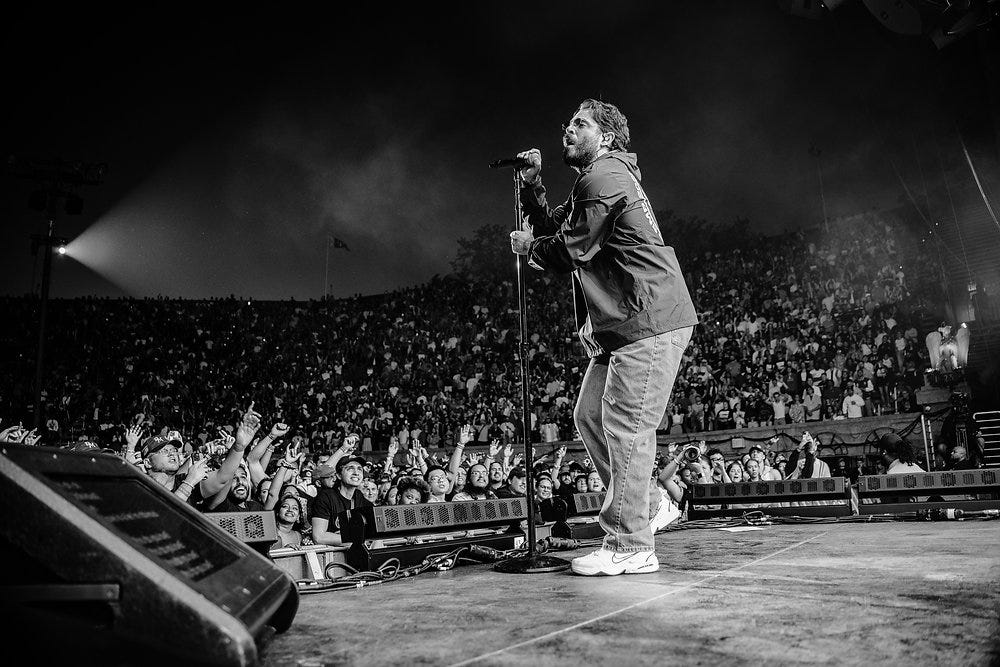
Jon Bellion walked away from his career for six years. He started his own label and came back on his own terms, where he released his album Father Figure, and then played two sold-out nights at Forest Hills Stadium. He made more in those two nights than he had in entire previous tours combined.
How? Because he understood the business. Because he waited until he had leverage. Because he was willing to do the unglamorous work of figuring out how the system actually functions. He says,
“Some people care about boxed wine, some people care about stomping on the grapes. Sometimes boxed wine sells because a 21-year-old who’s going to a party just needs to grab something at 7-Eleven. That’s viable, that’s real, and that’s a necessity.”
He’s not saying boxed wine is better than small-batch natural wine. He’s saying they both exist. And if your goal is to serve, if you want your music to reach millions of people and sustain you, you can’t always get your way 100% of the time.
There is no right or wrong here. It’s all about being honest with your goals and coming to terms with what the necessary steps are to make that a reality.
What If the Enemy Isn’t the Enemy?
What if the tools we think are ruining art (TikTok, algorithms, promotional content) aren’t the enemy? What if resisting them is just our ego protecting itself from having to grow?
What if, by letting go of the romanticized version of how this should work, we actually open ourselves up to something bigger than we imagined? What if the artist who’s willing to post the cringe Reel, learn the business, test their music, and adapt... what if they’re not selling out, but setting themselves free?
Bellion also said: “As you get more experience, your certainty decreases. The only things I’m certain of are the things that I can’t pin down.”
My takeaway: you have to learn the rules before you can break them. Get in the room. Learn the business. Try the tools. The more you understand how it all works, the clearer it becomes what fits you and what doesn’t. That’s when intuition becomes reliable, when it’s informed by experience, not just protecting your ego.
Because the self-label path is about understanding the game well enough that you can play it on your own terms, with both your humanity and your vanity intact.
It’s messy. It’s muddy. It’s uncomfortable.
But as Julia Cameron wrote in The Artist’s Way:
“It is impossible to get better and look good at the same time.”
So what’s the one thing that makes you feel uncomfortable but deep down you know you need to try? Where do you feel your ego fighting against what might actually help you?
I’m sitting with these questions too. Drop a comment and let’s think through this together.
Love the idea of letting go of the romanticized version of how things should play out, and instead focus on the work
So many great points here. A willingness to try different approaches is definitely a necessity these days. And I would think that for anyone who wants to enjoy a sustainable career in music, it'll be an aspect of their career that they'll have to constantly navigate and adapt to the changing times and tools.