


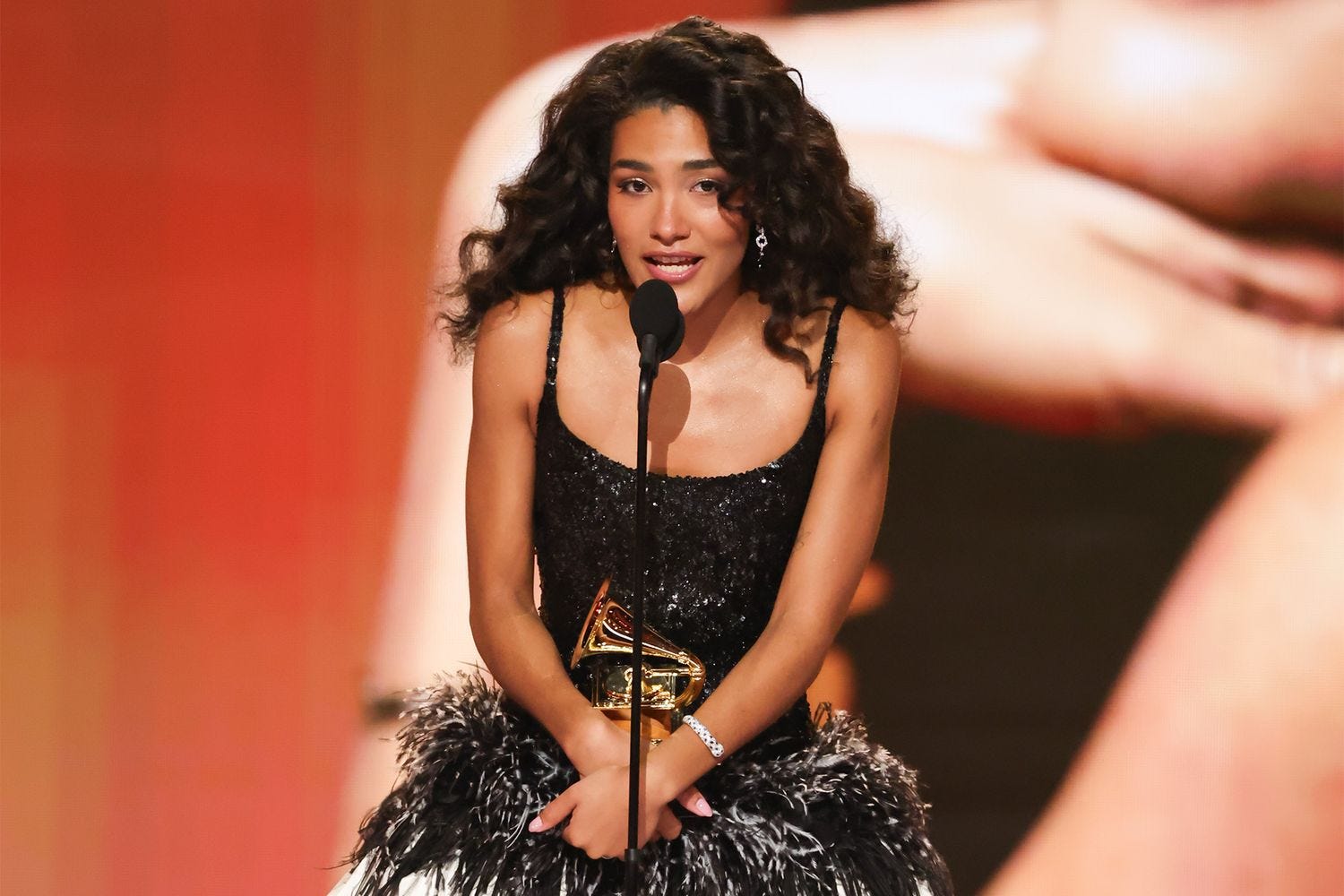
Olivia Dean just won Best New Artist at the 2026 Grammys. And if you watched her acceptance speech, you saw something refreshing: an artist who looked genuinely stunned. She took the stage in tears, hugged Chappell Roan, and said, “I never really imagined that I would be up here.”
She thanked her “best friend and manager” Emily, the same manager who discovered her at a school showcase ten years ago. “An artist is really nothing without their team,” she said.
And then she addressed the room. “I’m up here as a granddaughter of an immigrant. I’m a product of bravery, and I think those people deserve to be celebrated. We’re nothing without each other.” Very much in line with her hit album, The Art of Loving. A quiet, powerful statement at a time when the world needed to hear it.
If you're a self-label artist who needs a reminder that patience and artistic integrity actually lead somewhere, this one is for you.
Her rise is one of the strongest cases I've seen for why artistic integrity still wins - even in an industry obsessed with trends.
Yes, She’s Signed. That’s Not the Point.
Olivia Dean is signed to Capitol Records UK, in partnership with Island Records in the US. She has a label and a team. She has infrastructure that most of us are still building.
But the things that drove her success are tools that self-label artists have access to right now.
Patience. Authenticity. Artistic clarity.
Refusing to chase trends that don’t feel aligned. Building a body of work that means something before expecting it to perform.
Those are all choices.
And the people around her campaign keep saying the same thing. Her label’s managing director, Tom Paul, told Billboard that her biggest moments on social media “have always come from fans, not marketing.” EMI’s Rebecca Allen said they never forced her to work with anyone, and that Dean herself would push back on anything that didn’t feel authentic.
That kind of alignment happens when an artist knows who they are.
Seven Years of Becoming
Dean self-released her debut single, “Reason to Stay,” in 2018. She’d taught herself guitar and piano as a teenager, busked on London’s South Bank, and eventually caught her manager Emily Braham’s eye during a performance at the BRIT School where she was a student.
Her first EP was recorded in a converted pub in East London.
Between 2019 and 2023, she released multiple EPs and a debut album, Messy, which peaked at No. 4 on the UK Albums Chart and was shortlisted for the Mercury Prize. But it didn’t break her globally. Not yet.
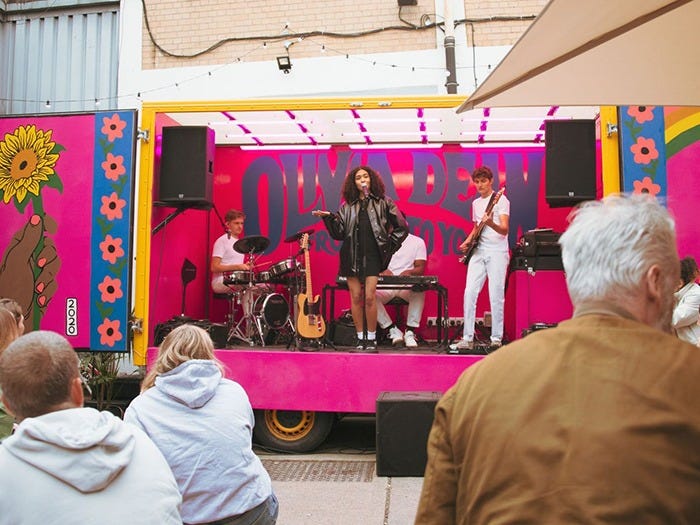
During the pandemic, when most artists were scrambling to figure out TikTok, Dean travelled the UK in a bright yellow truck sponsored by Clarks, performing mini-gigs in seaside towns. The crowds were often sparse. Some shows were held in a prawn restaurant.
Yes, a prawn restaurant.
She showed up in person, connected through performance, and kept building even when the numbers didn’t justify it.
Then came The Art of Loving in September 2025. It debuted at No. 1 in the UK, Australia, Ireland, and New Zealand. “Man I Need” hit No. 1 in the UK and No. 2 on the Billboard Hot 100. She became the first British female solo artist to simultaneously have four Top 10 singles on the UK chart.
Seven years. From a pub EP to a Grammy.
The Anti-Trend Strategy
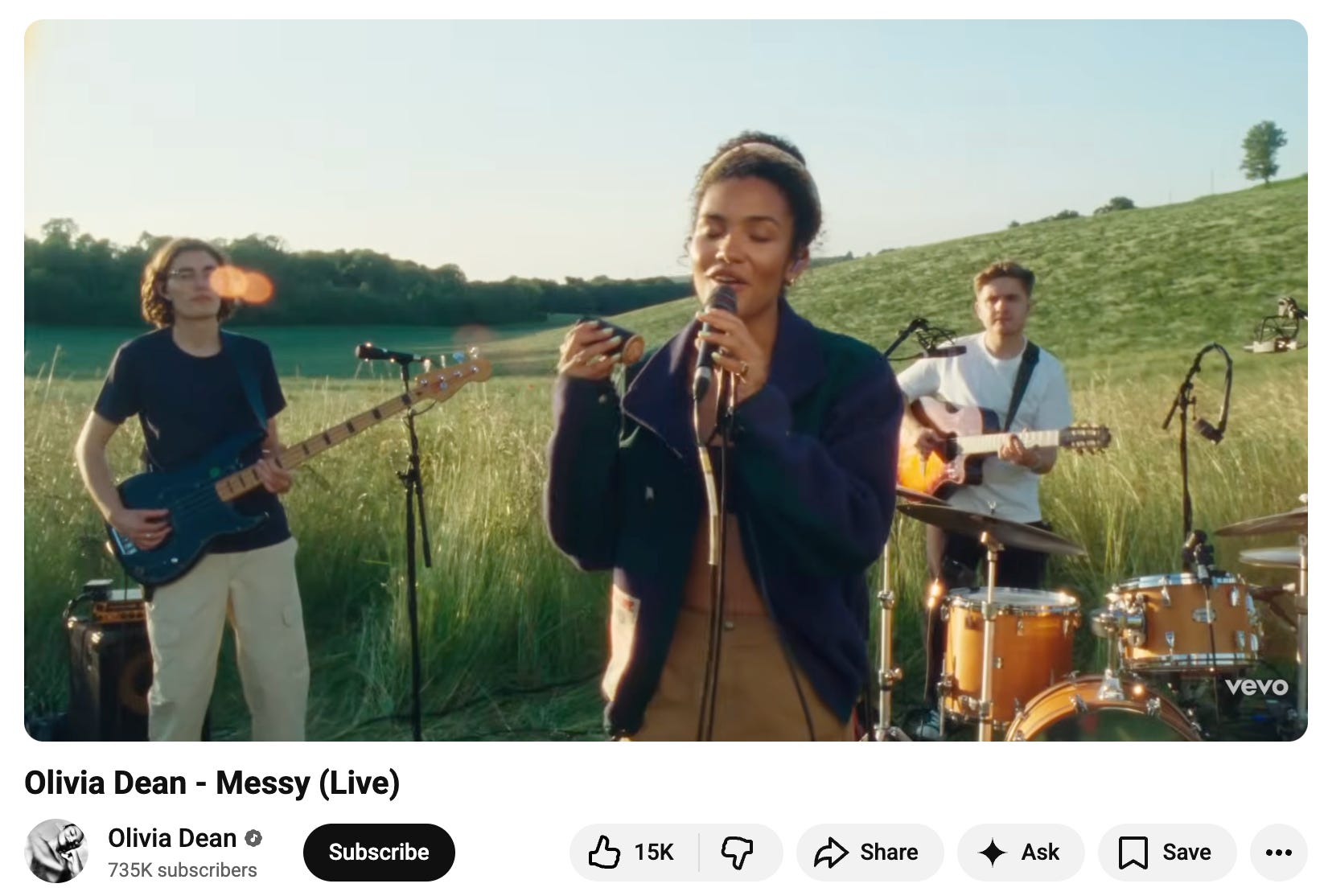
Dean told Music Week in 2023:
“I’m a pretty old soul. I like live gigs, I like doing stuff with bands and I don’t like TikTok. I would never post a video of me talking into my phone because it creeps me the hell out.”
While the industry was telling artists to test hooks on TikTok before finishing songs, to let engagement metrics guide creative decisions, to optimize for the algorithm, Dean was doing the opposite. But it wasn’t a smooth process.
On the And the Writer Is.. podcast, she described a stretch during the making of The Art of Loving where nothing was working. She’d written a few songs she liked early on, but then hit a wall. “There was a whole middle chunk where I was like, I don’t know what the hell I’m doing,” she said. The material wasn’t landing. She had no desire to release it or keep working on it.
Then she visited an art exhibition in LA called All About Love, inspired by bell hooks’ book of the same name. Something clicked. She said,
“It would be interesting for me to make an album in response to the book and the exhibition, and do like a case study almost on love.”
That became the creative anchor for everything that followed. From there, she recorded in a house in East London converted into a live-work studio for eight weeks, making complete songs meant to be listened to as a body of work.
Dean released only one track in an entire year and still sold out multiple London venues. “She was building this audience by putting out very little,” Allen said, “but it was quality content.”
Quality over quantity. That's not about perfectionism or waiting years between releases. It's about taste. Knowing the difference between 'this needs more time' and 'I'm stalling.' Dean knew and that's why it worked.
What the Fans See Is Everything
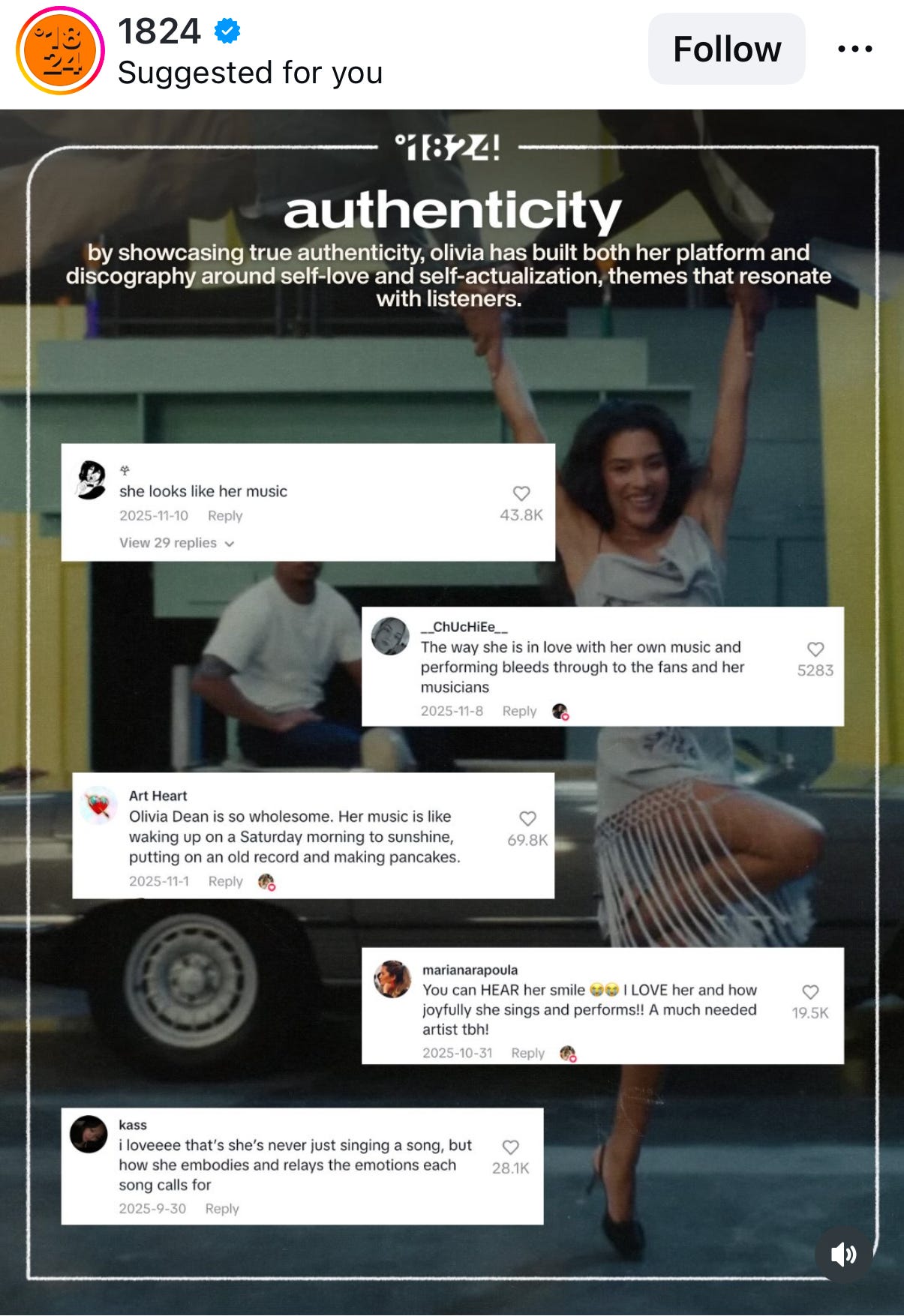
“She looks like her music.”
“Her music is like waking up on a Saturday morning to sunshine, putting on an old record and making pancakes.”
“You can HEAR her smile.”
“The way she is in love with her own music and performing bleeds through to the fans and her musicians.”
Every comment is about how she makes them feel.
When an artist actually means what they’re making, people can tell. That’s what makes someone hit replay. That’s what makes someone buy a ticket.
That only comes from meaning it.
Your Self-Label Playbook Inside Her Story
1. Know who you are before you ask the world to care.
Dean spent years figuring out her artistic identity. She experimented and released EPs that performed well on streaming but didn’t translate into widespread recognition. She didn’t rush to become something she wasn’t. And when the industry pushed her to fit a specific mold of artists her age, her manager championed Dean’s vision to develop her own Motown-infused soul sound instead.
That kind of alignment doesn’t happen by accident. It happens when an artist knows what they’re building and the people around them respect it.
As a self-label artist, you have something Dean had to negotiate for: full creative control from day one.
2. Your live presence is your strongest asset.
Dean’s team figured out early that her live energy was where the magic was. The Jazz Cafe recordings. The yellow truck tour. Clips of her singing with just a guitar on a balcony in Brazil. Every one of these became organic social content that outperformed any marketing push.
You don’t need a label budget for this. You need a phone, a good room, and the willingness to perform even when the crowd is small. And always film it because that footage will always connect deeper than a video following a trend.
3. Let your creative starting point be something real.
Dean’s album The Art of Loving was inspired by Mickalene Thomas’ art exhibition and bell hooks’ writing about love.
If your starting point is “what will perform well,” you’re building on sand. The stuff that actually connects is specific, deeply personal and rooted in something you felt and experienced.
4. Patience is a strategy.
Billboard’s post-Grammy analysis called Dean’s rise “a lesson in letting potential unfold in its own time.” Her manager Emily Braham put it more directly:
“Instead of having one big break, it’s about building a really good business and catalogue of music.”
This is the part most self-label artists struggle with. You see peers pulling ahead and wonder if something is wrong with your approach. But consistently releasing quality work, building a catalog that means something, showing up with integrity over time... that compounds.
5. Commit to it.
FKA twigs, who also won a Grammy that night, said something that stuck with me:
“To any artist: Don’t give up, follow your vision, do you, because that’s what’s going to make the world fall in love with your art.”
Just because something isn't hitting doesn't mean it's not working. It might take years. Switching directions every time something underperforms doesn't just slow your momentum - it confuses the people trying to follow you. Commit to your identity. No one else is going to show up for you the way you can show up for yourself.
The Deeper Question
If Dean’s story proves anything, it’s that artistic integrity builds over time.
The label infrastructure helped scale her globally. But her voice, her emotional clarity, her refusal to be anything other than herself - all of that existed before the label got involved. That was hers.
As a self-label artist, you’re building the same thing. You’re building the art and the infrastructure at the same time. That takes longer and yes, it requires more patience and discipline. It means some seasons will feel unbearably slow.
I often compare the mindset this requires to an athlete’s. I grew up playing competitive tennis and I can tell you that when a player loses a match, they don’t quit the sport or overhaul their entire technique. They regroup, review what could be better and the next morning, they’re back on the court showing up for themselves and focusing on what they can control and improve. The career doesn’t reset after a loss -it continues. That’s the discipline self-label artists need too. Stay on the court and keep refining.
The foundation you’re building is yours. The catalog is yours. The relationship with your audience is yours. And when the moment comes, whether that’s a sync placement, a viral fan post, or something you can’t predict yet, you’ll be ready. Because you put in the hours becoming undeniably you.

What part of Olivia Dean’s approach resonates most with where you are right now? And what’s one thing you could commit to doing differently this month because of it?