


Welcome to Your Monday Music Briefing, your weekly roundup of what caught my attention last week that felt important for self-label artists to know.
‘Say No to Suno’: Artist Rights Groups Push Back Against AI Music Company
A coalition of artist rights organizations published an open letter titled “Say No to Suno,” calling out the AI music platform for what they describe as unauthorized training on copyrighted music and flooding streaming platforms with AI-generated content. Signatories include the Music Artists Coalition, the European Composer and Songwriter Alliance, the Artist Rights Alliance, and several other advocacy groups. The letter accuses Suno of being a “brazen smash and grab” operation and draws a pointed comparison to the recent Louvre jewelry heist. The campaign arrives during a turbulent stretch for Suno, where the company simultaneously announced 2 million paid subscribers and $300 million in annual revenue, while still facing active copyright lawsuits from UMG and Sony. The letter also raised concerns about Deezer’s research showing that up to 85% of streams on fully AI-generated tracks are fraudulent.
Sono Hikari Take: The timing of this letter couldn’t be more strategic. The same week artist advocates publicly call Suno a threat to the creative ecosystem, the company reports numbers that prove millions of people are paying for exactly what artists are protesting. What’s also worth paying attention to is the “walled garden” debate underneath all of this. UMG’s licensing deals with Udio require AI-generated music to stay inside the platform and not be distributed elsewhere. Suno’s deal with Warner doesn’t include that restriction. The industry is splitting into two camps over whether AI-generated music should be allowed to leave the platform where it was created. That question will shape how much AI content ends up competing with your music on streaming platforms, and how royalty pools are affected.
The fraud numbers from Deezer also deserve more attention than they’re getting. If 85% of streams on AI-generated tracks are artificial, this isn’t just an artistic integrity issue - it’s a direct financial hit on the royalty pool that pays real artists. Every fraudulent stream on an AI-generated track is money that doesn’t go to artists.
For Self-Label Artists: The practical move right now is the same one it’s been: make sure your catalog is properly registered, and your metadata is airtight across every platform. As detection tools, licensing frameworks, and compensation models emerge, the artists who benefit first will be the ones whose ownership is documented clearly and completely. Also worth checking - does your distributor have AI licensing settings you don’t know about? Know what you’ve opted into. The decisions being made at the industry level right now will affect your royalty statements within the next year.
TIDAL Expands Its Spotlight Program to More Artists
TIDAL has expanded its Spotlight program into Canada, the UK, and several European markets, opening up editorial promotion and cash awards to more independent artists. The program is tied to TIDAL Upload, the platform’s direct publishing tool, where artists upload original tracks, make them public, and become eligible for editorial placement and a one-time $1,000 award if selected by TIDAL’s editorial team. There’s no separate application process. Eligible countries now include the US, Canada, UK, Germany, France, Spain, Poland, Sweden, Netherlands, Norway, and Switzerland.
Sono Hikari Take: This is a small but meaningful signal. In a landscape where algorithmic discovery dominates, and most platforms reward existing momentum, TIDAL is pairing human editorial curation with direct financial incentives. A $1,000 award won’t transform anyone’s career, but the model itself is interesting - it says that editorial selection based on musical quality should come with compensation, not just a playlist add and a pat on the back.
I recently visited TIDAL in New York City, and their passion for supporting artists was refreshing to experience. Their staff prides itself on actually listening to every single submission. They’re aware they’re a small team, and they’re not trying to compete with Spotify - their focus is providing meaningful service to artists with artist-friendly payouts, and they’re able to do that because they’re a subsidiary of Block, the financial company. It will be interesting to see how their business shifts amid Block’s recent major layoffs, but regardless, TIDAL is a platform independent artists should be taking advantage of.
The deeper point here is the philosophy behind it. Most streaming platforms treat playlist placement as a favor. TIDAL is treating it as something that deserves payment. For independent artists who often pour hundreds or thousands of dollars into releases without any guaranteed return, a platform that pays you for being selected, rather than expecting you to pay for promotion, is a different value proposition entirely.
For Self-Label Artists: If you’re distributing to TIDAL and you’re in an eligible country, make sure you’re using TIDAL Upload for your original releases. The barrier to entry is low, and there is no pitching process, no gatekeeping beyond your distributor. The editorial selection is competitive, but the combination of visibility and a cash award makes it one of the better risk-free opportunities available to independent artists right now. Even if you don’t get selected, having your catalog present on TIDAL Upload positions you for future consideration.
Primary Wave Nears Deal to Acquire Kobalt, Which Would Create a $7B Indie Music Powerhouse
Primary Wave is reportedly in advanced negotiations to acquire Kobalt Music Group, the world’s largest independent music publishing administration company. If the deal goes through, the combined entity would represent over $7 billion in assets. Primary Wave’s portfolio includes stakes in the catalogs of Prince, Whitney Houston, Bob Marley, and Britney Spears. Kobalt administers over 1 million songs and represents songwriters including Max Martin, Karol G, Andrew Watt, and Phoebe Bridgers. The deal would give Primary Wave its own publishing administration infrastructure for the first time, plus control of Kobalt’s AMRA digital royalty collection operation, which collects directly from streaming services rather than routing through local societies. Kobalt is currently generating roughly $100 million in EBITDA and could fetch a sale price exceeding $1.5 billion.
Sono Hikari Take: Kobalt built its reputation as the tech-forward alternative to traditional publishing with transparent royalty tracking, faster payments, and a platform designed for self-publishing songwriters. Primary Wave is a catalog acquisition machine with deep pockets and a roster of iconic legacy rights. When these two models combine, the question is which philosophy wins.
Kobalt’s newer service, KOSIGN, which provides publishing administration to independent songwriters who often have no other way to collect publishing royalties on their masters, is a growing part of this equation. If you’re an independent artist releasing music and not collecting your publishing royalties - and many aren’t -services like KOSIGN, Songtrust, and Word Collections exist to close that gap. Whether this acquisition strengthens or deprioritizes that side of Kobalt’s business is worth watching.
This deal also sits alongside BMG’s reported talks to acquire Concord. Two of the biggest independent music companies could change hands in 2026, which means the “independent” sector is consolidating in ways that start to look less “independent” by the year.
For Self-Label Artists: If you’re not collecting your publishing royalties, this is your reminder. Every time your song is streamed, there are two sets of royalties: one for the recording (your master) and one for the composition (your publishing). Most independent artists collect the first and most think that their PRO covers all their publishing royalties. Services like KOSIGN and Songtrust close that gap.
Google Acquires AI Music Startup ProducerAI
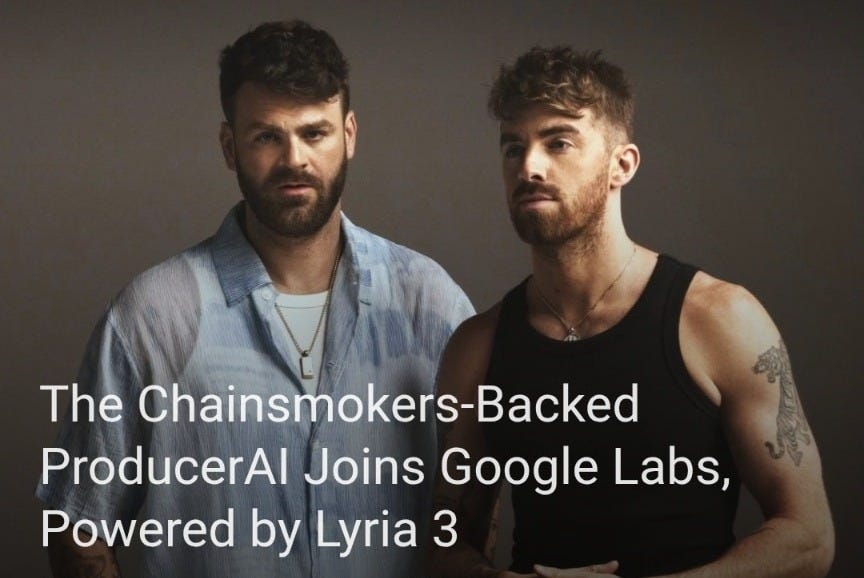
Google has acquired ProducerAI, the AI music creation platform formerly known as Riffusion, and brought the team into Google Labs. ProducerAI uses Google DeepMind’s Lyria 3 model to let users generate tracks, remix audio, write lyrics, create album art, and produce music videos through an interactive AI agent. The platform was developed in collaboration with The Chainsmokers and Grammy-winning rapper Lecrae. All content created through ProducerAI is embedded with SynthID, Google’s imperceptible watermark for identifying AI-generated content. The acquisition came just one week after Google launched Lyria 3 inside Gemini, which generates up to 30-second music clips for consumer use. ProducerAI is available globally with free and paid plans.
Sono Hikari Take: Google is making a clear two-pronged play in AI music. Lyria 3 inside Gemini is the consumer-facing side: short clips for social sharing and casual use. ProducerAI is the creator-facing side, with longer-form production tools aimed at people who actually want to make music. The fact that Google separated these two approaches tells you something about where they think the market is heading.
The SynthID watermarking is the detail I’m paying most attention to. If Google embeds an invisible, persistent watermark in every piece of audio generated through its AI tools, that creates a system where AI-generated content can theoretically be identified and tracked across platforms. That’s meaningful for the fraud and royalty dilution conversation happening around Suno. But it also raises a question worth sitting with: if an artist uses just one AI-generated part and the rest is human-played, their entire song could still potentially be flagged as AI. Whether other AI music companies adopt similar transparency measures, or are required to, will shape how this industry evolves.
The bigger picture: this acquisition happened the same week as the “Say No to Suno” campaign. Google is betting that the path forward is building AI music tools with artist endorsements and built-in identification systems, not fighting the copyright battles Suno is still fighting. Whether that approach earns trust from the broader creative community remains an open question.
For Self-Label Artists: AI music tools are not going away. They are getting more sophisticated, better funded, and more integrated into the platforms you already use. Your competitive advantage as a human artist isn’t that you can make music — it’s that you can make music that means something, that comes from somewhere real, and that carries a story only you can tell. That’s the part AI can’t replicate. Lean into it.
If You Missed It:
Demystifying Royalties: Understanding PROs, Publishing Admins, and SoundExchange
One Thing To Carry With You This Week
"To be yourself in a world that is constantly trying to make you something else is the greatest accomplishment." — Ralph Waldo Emerson