


If you’re a self-managed artist, you’ve already watched the tutorials, read the guides, and maybe heard someone casually drop the term “neighboring rights” in a session—cue the quiet panic that you might be missing yet another type of royalty you didn’t know existed.
Here’s the truth: you’re already doing a lot. You’re writing, producing, promoting, managing releases—all while trying to keep up with how the business side works. Royalty flow charts can get messy, fast. So don’t beat yourself up if you discover you’ve missed something.
By the time you finish this post, my hope is that you’ll understand exactly where your royalties come from, what you might be missing, and how to fix it moving forward.
The Three Core Royalties You Need to Know
Let’s start with the basics. Every stream, sale, or sync triggers multiple kinds of rights and royalties. Here’s the simple breakdown:
1. Master Royalties — for the recording.
If you own your master recording, you get paid by your distributor when your song is streamed, downloaded, or licensed (YouTube, TikTok, etc.)
2. Mechanical Royalties — for the composition.
Every time your song is reproduced (digitally or physically), you earn mechanical royalties for the songwriting portion of your song from your publishing admin.
3. Performance Royalties — for public use.
When your song plays on the radio, TV, a café, or a live stream, you earn performance royalties from PRO organizations like ASCAP, BMI, and SESAC.
These rights move through different organizations— and if your royalties sit unclaimed for years, they don’t just disappear — they often end up being absorbed into the general pool of large rights-holders (which tend to be major labels or big publishers) who had nothing to do with your independent track.
The Royalties Most Artists Miss
Most independent artists do the basics: they distribute their music, join a PRO like BMI or ASCAP, and assume they’re covered. The truth is—there’s more to it.
4. Digital Performance Royalties - for the recording.
These are royalties earned when your recording plays on non-interactive digital radio services such as Pandora, SiriusXM, or webcasters. Platforms where listeners cannot choose the songs to play next, skip ahead, or replay tracks.
If you haven’t registered with SoundExchange (the U.S. organization that collects them), those royalties could be sitting unclaimed. (soundexchange.com)1
5. Publishing & Mechanical Royalties - for the composition.
Even if you’re registered with a PRO, that only covers performance royalties. You still need a publishing administrator (like Songtrust, Sentric, or TuneCore Publishing) to collect your mechanical and global publishing royalties.
Without one, you could be missing 20–30% (or more) of your income from streaming and international plays. (songtrust.com)2
6. Neighboring Rights — The One Most Artists Miss
There’s one more layer of royalties many U.S. artists overlook: Neighboring Rights. These pay the master recording owner and performers (i.e., additional vocalists, session musicians) when the recording itself (not just the composition) is broadcast, played publicly, or streamed—especially outside the U.S.3
If you’re an independent artist, you may be missing these royalties entirely unless you’re registered to collect them.
If you’re a U.S. artist, here’s how it works:
Registering with SoundExchange ensures you collect digital performance royalties for your recordings in the U.S. (non-interactive streaming, etc.).4
To collect international recording-side royalties, you’ll need to register with foreign societies or use a neighbouring-rights administrator.5
This recording-side royalty stream is separate from what your publishing administrator (like Songtrust) collects for the composition side.6
In short: SoundExchange covers a portion of the recording-side royalties in the U.S. and their international service covers some international agreements—but not every territory or usage.
Some other services that help with neighboring-rights registration and international collection include Symphonic Distribution, Lime Blue Music, and AllTrack. It’s important to understand that while these companies aim for a broad reach, no service guarantees every country or every type of use.7
We’ll dive deeper into the different neighboring-rights services and what works for you in a separate post.
The Royalties Flow
Before we break this down — a head’s up:
Royalty flow charts notoriously get messy.
That’s because who earns what depends on ownership—whether you have a label, a publishing deal, sync deal or collaborators with split rights.
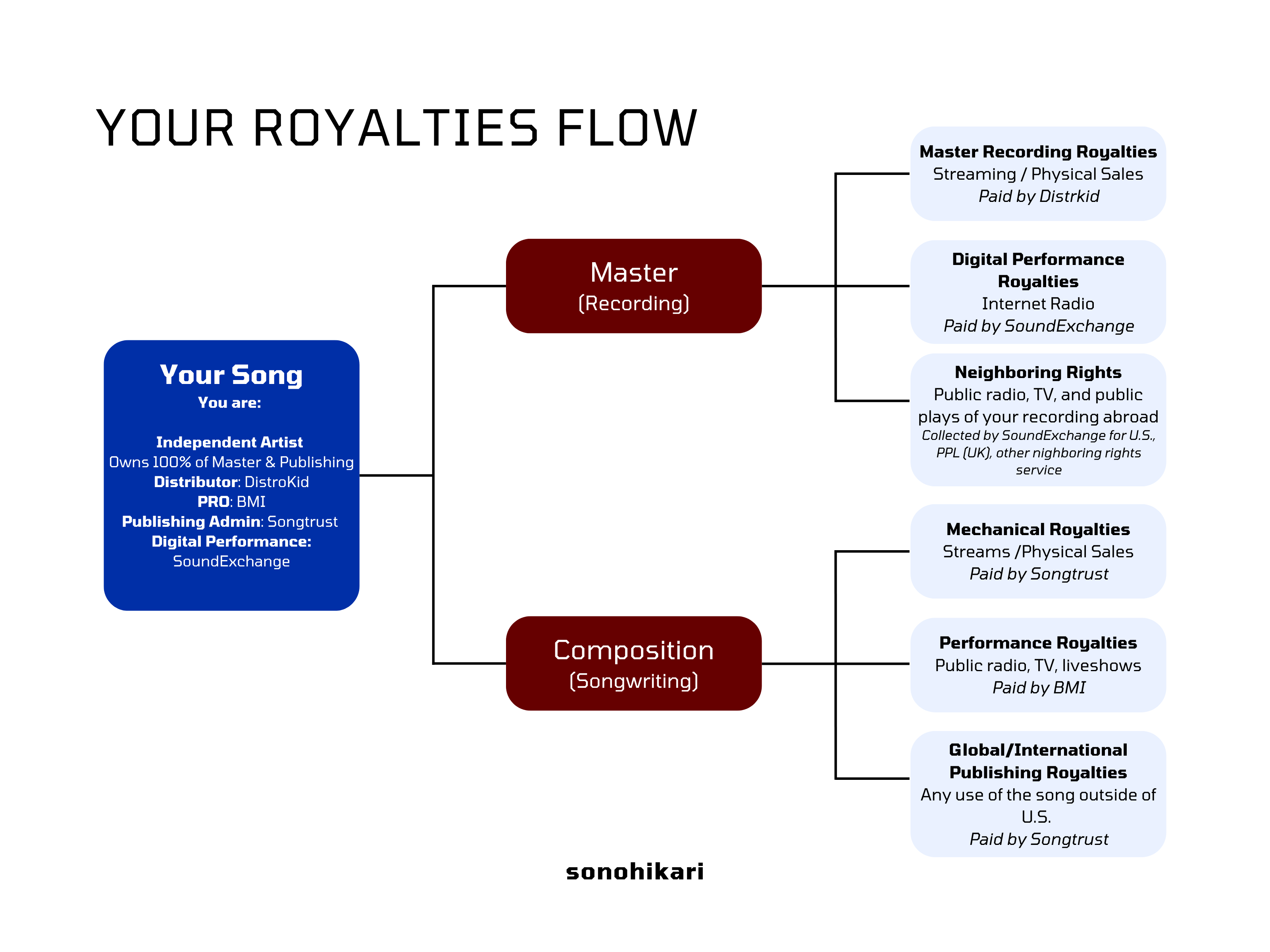
To keep things simple, the example below assumes you’re an independent artist who owns 100% of your master and publishing, not signed with a sync agency, and you’re not tied to a label or outside publisher.
This chart is meant to give you a clear baseline of how royalties flow when you distribute your own music, belong to a PRO, and have accounts with SoundExchange and Songtrust.
For this example, we’ll assume you’re releasing music through DistroKid and are registered with BMI. This is just a hypothetical scenario — not an endorsement of any specific platform.
Why This Matters
If you’re only collecting royalties from your distributor or PRO, you’re likely missing entire categories of income. Registering with SoundExchange and a publishing administrator like Songtrust ensures you’re getting both sides of what your music earns — master and composition.
And once you start to build traction internationally, adding a neighboring rights administrator can unlock another layer of royalties waiting overseas.
Going Forward: Secure Your Future Royalties
If you haven’t yet set up your accounts:
Register with SoundExchange — for U.S. digital performance royalties on your recordings (non-interactive streaming, etc.).
Opt-in to SoundExchange’s International Mandate — if you’re already registered, it lets them collect royalties when your recording is used overseas through their global partner agreements.8
Sign up with a publishing administrator (like Songtrust, Sentric, or TuneCore Publishing) — for composition-side mechanical and international publishing royalties.
Check your songs at The Mechanical Licensing Collective (The MLC) — many distributors (e.g., DistroKid) register your releases automatically, but you should still verify that you’re listed correctly so you don’t miss out.
Audit your catalog regularly — confirm every song has correct metadata, splits, and is registered in all required systems.
Look into neighboring rights administration — especially if your music is played overseas or placed in sync; for full global coverage, you’ll likely need a specialized admin beyond basic registrations.
By taking action today, you’re not just collecting what you’ve already earned—you’re building the foundation for sustainable income as your music grows.
Closing Thought
As artists navigating an industry that rarely values transparency—especially on the business side—we have to be more vigilant than ever.
As a self-managed indie artist, it can feel isolating to keep decoding this landscape on your own. But you’re not alone. And knowledge is power.
The real measure of success isn’t streams or followers—it’s building your own ecosystem. Big or small doesn’t matter; what matters is that it works for you because you understand exactly how you’re earning from your art. That clarity is power.
Drop your questions or comments below. I’d love to know what challenges you’re navigating right now and any helpful tips you’ve discovered along the way.
Coming Soon:
How to Choose a Neighboring Rights Administrator: What Indie Artists Should Know
https://www.soundexchange.com/frequently-asked-questions
https://blog.songtrust.com/the-guide-to-neighbouring-rights
https://soundcharts.com/blog/what-are-neighboring-rights-royalties
https://www.soundexchange.com/frequently-asked-questions
https://support.symdistro.com/hc/en-us/articles/203841599-About-Neighboring-Rights
https://blog.songtrust.com/the-guide-to-neighbouring-rights
https://www.alltrack.com/neighboring-rights/
https://www.soundexchange.com/international-partners/
this should be mandatory reading for any artist.
Renee, …just followed you, may do more. Found you from a reply to Joel Gouveia. … wanted to comment to you briefly directly, rather than post for all to read here. … (still mostly unfamiliar the Substack app), but your post raised my eyebrows enough to make my brain want to return. 😊