Welcome to Your Monday Music Briefing, your weekly roundup of what caught my attention last week that felt important for self-label artists to know.
J-Pop Is Finally Going Global, Here’s Why

When I started my Substack, my goal was to shed light on the world’s most mysterious music market - Japan. It is the second biggest music market in the world, and it’s been slowly exporting for some time now, but it’s finally making major headlines. For the first time ever, nearly half of the royalties Japanese artists earned on Spotify in 2024 came from outside Japan. The number of Japanese artists ranked among global superstars on Chartmetric tripled in a single year. YOASOBI’s audience sits at 65% international now. Kenshi Yonezu sold out Radio City. Anime tie-ins are doing a lot of the heavy lifting, and meanwhile, back home, physical formats still make up the majority of sales, with ¥52.8 billion (around $330M) in physical production in Q1 2026 alone.
Sono Hikari take: Read to the end of this piece, and you’ll find the line that matters: J-pop is going global by staying exactly what it is. These artists sing in Japanese. They keep the melodic sensibility that only makes sense if you grew up inside it, and they let anime carry the songs across borders instead of chasing Western radio formulas. Having worked between Japan and America, I've watched American execs write off Japan as this walled garden for years. Japan is a mystery to them, and it’s a hard egg to crack. They are not wrong, but I think that most are not creative enough to have a good strategy, because the opportunities are there.
For self-label artists: Your specificity is your export. What’s the thing about your music that feels almost too particular, too local, too you? Sit with that question this week, because it might be exactly what travels. Where could your music live beyond your own market without you changing a single note?
Live Clips Are Powering Artist Discovery With the Next Generation of Fans
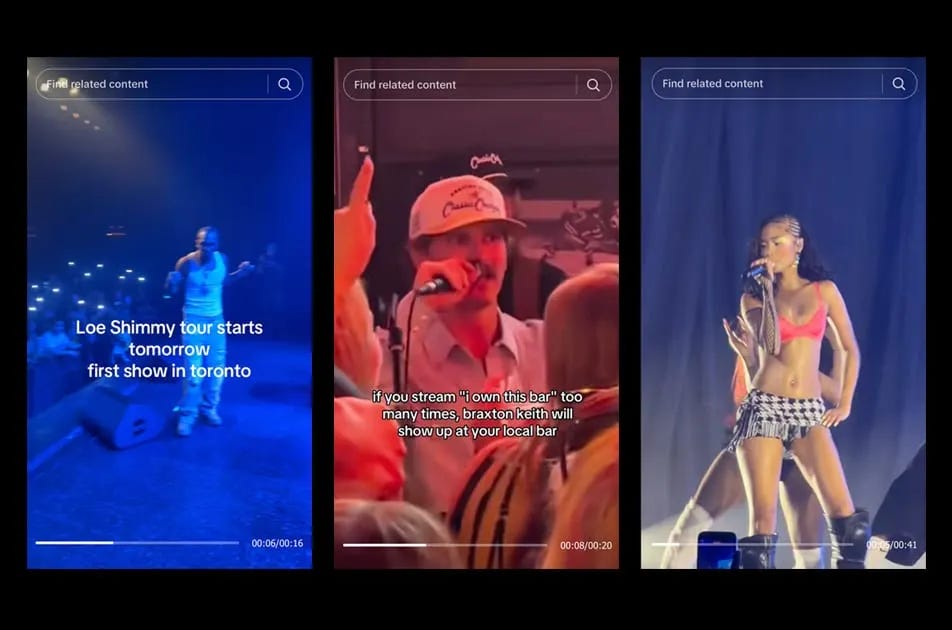
For decades the concert was the payoff at the end of fandom: hear the song, buy the record, wait for the tour. Now the fan journey has flipped: 82% of Gen Z listeners discover music through social platforms and user-generated video, and the clip that hooks them is usually a shaky vertical video of a live moment. A held note. A crowd screaming a chorus back. KATSEYE debuted an unreleased song on tour and let fan footage start the conversation before a studio version even existed.
Sono Hikari take: Before social media, artists relied on live shows to read the reaction of a new song. I recently heard Olivia Dean talk about how she still values that live reaction when she’s deciding if a song is worth the release. That human reaction is something that will always be important and telling. You can argue that social media is replacing that process with artists shoving songs down people’s throats hoping for some virality, but maybe the live reaction is existing in a different form. Watching a live clip doesn’t have nearly the same weight as hearing or seeing the show in person, but it still gives you goosebumps that you might not feel in a perfectly performed recording.
For self-label artists: Which moment in your live show do people often talk about after? That’s your clip. And when a stranger sees it and taps through, do you have a clear profile, a findable catalog, your next show listed? Discovery is just an introduction, but it’s your job to lead them to you as seamlessly as possible.
Major Record Labels Call to Disqualify AI Slop Songs From Global Charts
Nearly a dozen record companies, including Universal, Sony, and Warner, are calling on global chart companies to adopt new eligibility rules for AI-generated music. Under the proposal, an AI song could only chart if the AI use is lawful and authorized, the track is substantially human made, and there’s no whiff of streaming fraud or chart manipulation. Much of the AI music flooding streaming services is already linked to fraud, and this follows the RIAA and IFPI’s recent push for AI labels on streaming platforms.
Sono Hikari take: The same majors partnering with AI companies and settling lawsuits with Suno and Udio now get to decide where “legitimate” AI use ends. Classic. That said, I’m for chart standards here, because AI slop paired with bot streams drains the same royalty pool every real artist gets paid from, and I’ve seen firsthand how little transparency exists in those payout systems even on a good day. Keep your eye on the phrase “substantially human made,” though. Someone has to define it. Someone has to verify it. My prediction: proof of your creative process, your sessions, your stems, your messy voice memos, is about to become genuinely valuable. The receipts of being human are turning into an asset.
For self-label artists: Are you documenting your process? Session files, demos, songwriting drafts, and clean metadata already protect your royalties. Soon they may also serve as proof of authorship in a market learning to verify humanity. What would it look like to treat your creative paper trail with the same care a label would?
If You Missed It:
Decoding Japan: The World’s Second-Largest Music Market

Here is a pop quiz that stumps even the pros:
Read This Before You Use Suno

If you’ve been curious about AI music tools like Suno, or you’ve started using it for songwriting and demos, there are a few things you need to know about their updated terms of service.
One Thing To Carry With You This Week:
“Songs arise out of suffering. As far as I know, algorithms don’t feel.”
- Nick Cave